
Full Arch Dental Implants in Ireland
Fixed Bridge on 4 Implants – Permanent Teeth in Dublin
When you are missing most or all of your teeth, or you are currently wearing loose dentures, full arch dental implants can restore a complete, fixed smile using as few as four implants per arch.
At Dental Implants Ireland, our dentists provide full arch treatment using four strategically placed dental implants to support a fixed full arch of teeth, giving you stable, natural-looking teeth that do not move.
The typical cost for 4 Dental Implants and a Fixed Bridge/Full Arch is €7000.00

IDC Dentists with 5-star reviews
Enhanced aesthetics and self-confidence.

FASTER TREATMENT TIME

IMPROVED STABILITY

COST-EFFECTIVE

PREVENTS BONE LOSS
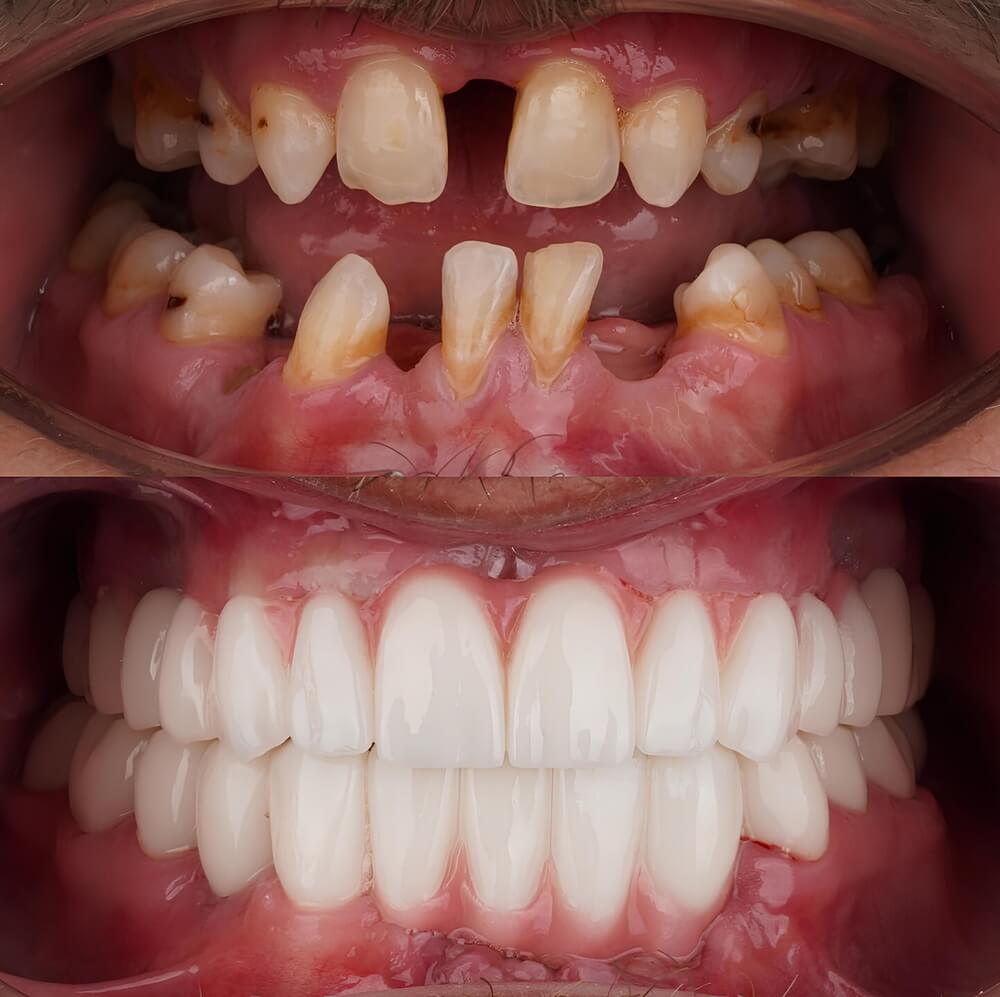

What Are Full Arch Dental Implants?
Full arch dental implants replace all teeth in the upper or lower jaw using a small number of implants to support a custom-made fixed bridge.
Instead of replacing every tooth individually, four carefully positioned implants can support a full arch restoration. This approach provides:
Fixed, non-removable teeth
Improved chewing and speech
Greater comfort than dentures
Long-term jawbone support
A natural appearance
This treatment concept is often compared to “All-on-4” style procedures, although specific systems and techniques may vary between clinics.
The typical cost for 4 Dental Implants and a Fixed Bridge/Full Arch is €7000.00
From Consultation to Smile
Detailed explanation of the Full Hybrid Single Arch on Four Dental Implants procedure.
The first step towards dental implants is a consultation with one of our implant-qualified dentists. During this visit, we carry out a thorough assessment of your teeth, gums, and jawbone to determine suitability for dental implant treatment.
Following this assessment, you will receive an initial quotation at your consultation, based on the clinical findings and your treatment goals.
A 3D CT scan is required before a full treatment plan can be created. The CT scan allows for precise digital planning of implant placement along with a fully transparent Treatment Plan and can be completed on the same day as your consultation (€200 for CT Scan and Treatment Plan) or scheduled for a later date if preferred.
Once CT imaging is completed, we will provide:
A personalised, detailed treatment plan
Confirmation of suitability for options such as a Full Arch on Four Dental Implants
Clear next steps and timelines
All quotations and treatment plans are tailored to each patient, as every dental implant case is unique.
On the day of your full arch dental implant procedure, local anaesthetic is used to ensure you remain comfortable throughout treatment.
Four dental implants are then carefully and strategically placed into the jawbone. Two implants are positioned at the front of the arch, with two placed at the back — one on each side. This configuration is designed to maximise support and stability, making effective use of the available bone, even where some bone loss has occurred.
This approach provides a strong foundation for a fixed full-arch restoration, allowing missing teeth to be replaced with a secure, non-removable solution.
After dental implant placement, some patients may choose a temporary denture (provisional prosthesis) that is not attached to the dental implants. This temporary denture allows you to maintain appearance and basic function during the healing phase, while the implants osseointegrate with the jawbone. Because it is not connected to the implants, it helps avoid placing pressure on them while healing takes place.
Over the following five months, the dental implants undergo a critical healing process known as osseointegration, where the implants gradually bond with the surrounding jawbone. This healing phase is essential for long-term success, as it creates a strong, stable foundation capable of securely supporting the final permanent teeth.
Once osseointegration is complete, the temporary prosthesis is replaced with a permanent implant-supported set of teeth. These final teeth are custom-made to fit your mouth precisely, providing a natural appearance, comfortable fit, and reliable chewing function that closely mimics natural teeth.

Our Advanced Approach

CBCT Scan in Clinic
Advanced 3D imaging of your jaw and bone structure for highly accurate and safer implant placement.

Digital Implant Placement PlanninG
Digital planning and surgical guides ensure precise implant positioning with minimal discomfort & faster recovery.
Secure, Natural, and Built to Last

Who Is Suitable for Full Arch Implants?
You may be suitable if you:
Are missing most or all teeth in one arch
Wear loose or uncomfortable dentures
Have failing teeth requiring full extraction
Have sufficient bone or are suitable for augmentation
Even patients with moderate bone loss may qualify due to the strategic angulation of implants.
A full assessment including CBCT imaging is required to confirm suitability.
The typical cost for 4 Dental Implants and a Fixed Bridge/Full Arch is €7000.00
- YOUR QUESTIONS, ANSWERED
Frequently Asked Questions
A dental implant is a widely used and effective solution for replacing a missing tooth. The implant itself is a small titanium screw that is placed into the jawbone in the area where the tooth is missing. After healing, a post (abutment) is attached to the implant, and a custom-made zirconia crown is then fitted on top.
Together, the titanium implant, post, and zirconia crown fully replace the missing tooth, restoring both natural appearance and chewing function. This complete tooth replacement is what most people refer to as a dental implant.
Our dental implant dentist will carry out a full oral assessment. You will receive an initial quotation at this stage. A 3D CT scan is required before a detailed treatment plan can be provided, as it allows accurate assessment of bone levels and implant positioning.
Once the CT scan is completed, a personalised treatment plan is prepared. For a single missing tooth, treatment typically involves one dental implant, one post (abutment), and one custom zirconia crown.
A dental implant offers several advantages over a traditional dental bridge. It looks, feels, and functions like a natural tooth and does not affect the healthy teeth on either side of the gap. In contrast, a dental bridge usually requires neighbouring teeth to be filed down to support the bridge.
Dental implants also replace the missing tooth root, helping to maintain healthy jawbone in the area of tooth loss. With a dental bridge, the bone beneath the bridge may gradually deteriorate. Because a dental implant integrates with the jawbone, it helps keep the bone strong and intact.
In addition, dental implants are easier to clean and maintain than bridges, reducing the risk of gum recession or visible margins over time. For many patients, this makes dental implants a more durable and long-term tooth replacement option.
Yes. There are different types and systems of dental implants, although around 99% of dental implants used worldwide are made from titanium. Titanium is widely used because it is biocompatible, strong, and able to integrate predictably with the jawbone.
While the material is usually titanium, there are hundreds of different dental implant brands and systems available. These systems vary in design, surface treatment, and connection type. Your dental implant dentist will select the most appropriate implant system based on your clinical needs, bone quality, and treatment plan.
A single dental implant can be used to replace one missing tooth, or multiple implants can be placed to support a fixed dental bridge when several teeth are missing. In suitable cases, using fewer implants to support a bridge can be a more cost-effective solution than placing one implant for every missing tooth.
All implant treatment is carried out by IDC-registered clinicians, in accordance with professional standards set by the Irish Dental Council.
Not everyone is suitable for dental implants. The ideal candidate for dental implant treatment is generally in good overall health and has healthy teeth and gums. Adequate jawbone is required to support the implant, and the gums should be free from active gum disease (periodontitis).
Certain medical conditions — such as diabetes, heart conditions, or the use of blood-thinning medication — may affect suitability for dental implant surgery. These factors do not always prevent treatment, but they require careful clinical assessment and planning.
Because dental implant placement is a surgical procedure, thorough pre-treatment evaluation and planning is essential. For this reason, dental implants should only be placed by a dentist with appropriate training and experience. At our clinic, all implant assessments and treatments are carried out by IDC-registered dentists, in line with professional standards set by the Irish Dental Council.
Dental implant treatment is carried out in stages. First, a titanium dental implant, shaped like a small screw, is placed into the jawbone where the tooth is missing. Over the following several months, the implant bonds with the bone through osseointegration, creating a strong foundation. During this time, a temporary tooth replacement may be provided.
Many dentists use one-stage dental implant systems, which avoid the need for a second procedure to place a healing cap.
Once healing is complete, a custom zirconia crown is attached to the implant using a small connecting post called an abutment. This restores natural appearance, chewing function, and speech.
Every dental implant case is different and is planned following a full clinical assessment.